
Trust in partnership
Connecting through tech
02
THE 2025 BUSINESS PERFORMANCE REPORT AND THE 2026 OUTLOOK
2025 Business performance report
2025 was a challenging year for the global economy and the Vietnam insurance market. Global economic fluctuations, increasingly competitive pressures in the insurance industry, along with higher requirements for risk management, information transparency and service quality, posed numerous challenges for insurance companies. In addition, natural disasters, storms and floods had heavily impacts on people’s lives and business activities.

In this context, Bao Long has proactively implemented flexible management solutions, promoted its development strategy in 2023-2027 period with a focus on upgrading system, digital transformation in product and service supply to enhance product quality and create better customer experience.

Upgrading System

Digital Transformation
In Product

Service Supply
Thanks to cultivating an unwavering business orientation and the spirit of solidarity of all employees, Bao Long continuously strengthened its distribution system nationwide. The Company has gradually expanded its modern distribution channels, insurance agent network and digital insurance platforms to better meet diverse demands of customers.
The achieved results in 2025 continued to affirm Bao Long’s adaptability and management capabilities in the context of numerous fluctuations. This was also an important foundation for the Company to enter a new period of development after 30 years of establishment and development towards stable and sustainable growth in the following years.
FINANCIAL PERFORMANCE
Business results
| ITEMS | 2025 Planned Million VND |
2025 Actual Million VND |
Actual/Planned % |
|---|---|---|---|
| Insurance operation | |||
| Premium revenue | 1,609,000 | 1,605,390 | 99.8% |
| Total expenses for insurance activities | 1,373,802 | 1,394,049 | |
| Gross profit from insurance activities | 235,199 | 211,340 | 90% |
| Financial investment | |||
| Financial income | 63,060 | 74,634 | |
| Financial expenses | 2,000 | 10,377 | |
| Gross profit from financial activities | 61,060 | 64,258 | 105% |
| Other income | - | (1,032) | |
| General and administration expenses | 240,135 | 232,707 | |
| Profit before tax | 56,124 | 41,859 | 75% |
Assets and Resources
| ITEMS | 2025 Planned Million VND |
2025 Actual Million VND |
Actual/Planned % |
|---|---|---|---|
| Professional Reserve Fund | 922,093 | 963,477 | 104% |
| Owners’ equity | 945,076 | 928,605 | 98% |
| Investment portfolio | 1,635,853 | 1,672,057 | 102% |
| Total assets | 2,681,000 | 2,773,717 | 104% |

Premium revenue
0
Billion VND

Profit before tax
0
Billion VND
BUSINESS SOLUTIONS IMPLEMENTATION RESULTS IN 2025
2025 marked the third year of Bao Long’s 2023-2027 business strategy, emphasizing three strategic priorities: (1) Technologization, (2) Operational Capacity, and (3) Culture and brand name.
Additionally, Bao Long focused on five solution areas to achieve its goals: (1) Performance, (2) Expertise, (3) Creative Innovation, (4) KPIs, and (5) Bolding.
The results achieved in 2025 are as follows:

Group 01. Performance
- Megamind digital insurance system successfully went-live for cargoes & vessels;
- Completing the implementation of products on personal insurance distribution platform (Sales Platform) and connecting with organizations, partners, banks, e-wallet via Application Programming Interfaces (API) for sales (Bao Minh Khang, LivWell, Fuse, etc.);
- Deploying online payment approval system to strengthen connectivity between Bao Long and banks;
- Reviewing and updating internal procedures and regulations regarding labor based on new legal regulations issued by the State management agencies. The adjustment must follow a specific roadmap to ensure compliance with legal regulations and in accordance with Bao Long’s operation situation.

Group 02. Expertise
- Improving quality of insurance agents. Reviewing and converting insurance agent certificate according to new regulations of State management agencies. The conversion process has been synchronously implemented in the systemwide and completed on schedule.
- Assigning the job of unit restructuring to regional director to enhance the “localism” and boosting restructuring process.

Group 03. Creative Innovation
- Increasing automation via improved Megamind system. Implementing automatic debt management system with Megamind. Users of contract managers will be automatically blocked by the system due to overdue payments as stipulated. Accordingly, average percentage of original insurance premiums in 2025 reduced to 3.0% compared to 2024 (3.6%);
- Deploying online payment solutions and credit cards in the systemwide.

Group 04. KPIs
- Reviewing KPIs in the systemwide, adjusting, supplementing targets appropriate with practical operation situation and business orientation of Bao Long.

Group 05. Bolding
- Organizing programs of celebration of 30 years of establishment, including: uniform T-shirts, monthly lucky draw, video clip creation contest “The Bao Long Story – Carp transforming into dragon”, “Run for the future” marathon tournament, “The Voice of Bao Long” art competition, knowledge contest, year-end party – rewarding excellent units/individuals and honoring their contributions to the 30-year journey of Bao Long.
MACROECONOMIC AND VIETNAM’S NON LIFE INSURANCE MARKET PROSPECTS
Global economy
2026 is forecast to be another challenging year for global macroeconomy. Some factors such as geopolitical uncertainty, energy price fluctuations, trade tensions, climate change which become a major risk to many countries.
The biggest impact was geopolitical tensions in the Middle East, especially USA-Israel and Iran conflict which had introduced a geopolitical shock on global energy and supply chain. Rising oil prices and transportation have been causing significant volatility in international financial markets. Rising energy prices and production costs could drive higher inflation in many economies and slow global economic recovery and growth. Before February 28, 2026, many international organizations predicted that global economy in 2026 could grow by over 3%, but it was projected at lower growth rate after the outbreak of conflict depending on the course of the war.
Apart from geopolitical risks, US trade policies also have been shaking the global economy. The US imposed a temporary import tariff of 10% - 15% on goods from almost countries imported to the US to protect the local production and reduce trade deficit. The US move could raise trade tensions when many big economies expressed their concerns and vowed their countermeasures.
In addition, climate change had direct impacts on many sectors of the global economy in 2026 such as agriculture, food security, energy, trade and supply chain.
Vietnam Economy
On November 13 2025, the National Assembly approved the Resolution on socio-economic development 2026 with GDP growth of 10% & up. This target was set before the US-Israel & Iran war started on February 28 2026, commitments to promoting trade growth of the Government, infrastructure investment and impetus from export and FDI. After this period, OECD and international financial institutions predicted that Vietnam is projected to grow by 5-7%.
Import-export has become strategic growth pillar of Vietnam Economy, but 2026 is facing pressures from a declining demand in big economies such as US, China and European countries, along with increased trade protectionism and strict green standards.
Inflation pressures are forecast to have a delayed effect due to high credit growth in the previous year, along with oil price & input material price fluctuations. These push up capital costs and cause big pressures on domestic price level.
Beside economic and political factors, Vietnam is considered as one of the countries most affected by climate change which poses risks to agricultural production and infrastructure development.
Beside potential risks, Vietnam economy in 2026 emerged as a rare bright spot. Public investment continues to play a leading role,FDI flow remains stable which supports improving production capacity and technology transfer. At the same time, the process of institutional reform, streamlined administrative apparatus is expected to better improve investment environment and reduce administrative procedures.
In 2026, total non-life insurance premium revenue is projected by management agencies at nearly 98,371 billion VND, up nearly 11.25% as of 2025. The forecast was made in early 2026. However, when US-Israel and Iran war began on February 28, 2026, many experts say that this plan is very challenging when insurance market is facing big impacts from global and local economies.
First, the local non-life insurance market faces changes caused by US-Israel and Iran conflict. Specifically, international reinsurance companies will tighten their terms and conditions, exclude insurance or drive up insurance premiums which have direct impacts on business profit margin. High inflation also have impacts on claims costs for vehicles and health insurance lines.
In addition, increasing impacts of climate change, natural disasters and catastrophic risks also drive up claims costs for insurance companies, it requires insurance companies to enhance their risk management capabilities and adjust their pricing policies accordingly.
Apart from difficulties in insurance business, the downward interest rate will have impacts on profits of insurance companies in the coming time when a majority of profits of non-life insurance companies earned from bank deposits.
A bright spot of non-life insurance sector in 2026 lies on improved legal framework which removes obstacles for insurance companies, enhanced inspection and supervision of management agencies also create a foundation for safe, stable and sustainable development of insurance market in the coming time.
GOALS IN 2026
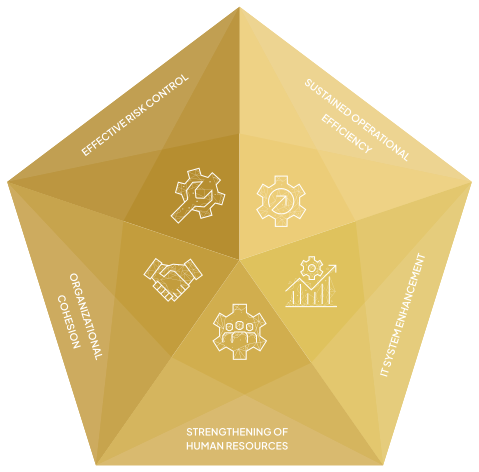
2026 marks the fourth year of Bao Long’s implementation of its 2023-2027 business strategy. Amid rising global political and economic risks and local economic growth challenges, Bao Long will continue to focus on core issues, prioritizing system stability and operational safety. Key goals include effective risk control, sustained operational efficiency, it system enhancement, and the strengthening of human resources and organizational cohesion.
The goals for 2025 are aligned with the 2023-2027 development strategy, emphasizing three strategic priorities:


BUSINESS SOLUTION AND ACTION PLAN IN 2026
FINANCIAL PLANNING 2026
| ITEMS | 2025 Actual Million VND |
2025 Estimated Million VND |
Growth % |
|---|---|---|---|
| Insurance operation | |||
| Premium revenue | 1,605,390 | 1,610,000 | 0% |
| Total expenses for insurance activities | 1,394,049 | 1,390,325 | |
| Gross profit from insurance activities | 211,340 | 219,675 | 4% |
| Financial investment | |||
| Financial income | 74,634 | 70,000 | |
| Financial expenses | 10,377 | 5,000 | |
| Gross profit from financial activities | 64,258 | 65,000 | 1% |
| Other income | (1,032) | - | |
| General and administration expenses | 232,707 | 237,676 | |
| Profit before tax | 41,859 | 47,000 | 12% |
Assets and Resources
| ITEMS | 2025 Actual Million VND |
2025 Estimated Million VND |
Growth % |
|---|---|---|---|
| Professional Reserve Fund | 963,477 | 980,000 | 2% |
| Owners’ equity | 928,605 | 966,000 | 4% |
| Investment portfolio | 1,672,057 | 1,672,000 | 0% |
| Total assets | 2,773,717 | 2,828,000 | 2% |
HUMAN RESOURCES AND TRAINING
BAO LONG HAS CONSTANTLY BELIEVED THAT BY MAXIMIZING EACH EMPLOYEE’S MOTIVATION, BAO LONG CAN INCREASE CUSTOMER SATISFACTION AND CONTINUALLY INCREASE THE VALUE FOR SHAREHOLDERS. BAO LONG ALWAYS STRIVES TO CREATE A WORKING ENVIRONMENT IN WHICH EVERY MEMBER FEELS SATISFIED WITH THEIR WORK AND PROMOTES THEMSELVES TO CONTINUE DEVELOPMENT DURING THE MONTH.
RISKS AND RISK MANAGEMENT
In the context of increasingly competitive insurance market in Vietnam, strongly impacted by macroeconomic fluctuations, climate change, technology risk and ever-increasing legal compliance requirements, risk management becomes a core pillar of sustainable development strategy of insurance companies in general and Bao Long in particular. Risk management not only helps Bao Long identify, evaluate, measure, write potential risk scenarios but also supports Bao Long to make decisions, optimize efficiency of capital use and enhance competitiveness
In line with common orientation of Bao Long in the new period, risk management is built upon the following principles and orientations:

Risk management policy
It requires a clear, transparent risk management policy, Bao Long clearly defines material topics and related risks arisen from business activities, risk appetite, market risk and how to manage each type of risk.

Material topic management
Identifying, measuring, evaluating and monitoring material topics; applying risk management in all business activities of Bao Long including insurance risk, market risk, operational risk, counterparty risk, liquidity risk.

Integrating risk management with business strategy
Implementing risk assessment for every decision regarding products, market, investment, reinsurance and distribution – profit within the same framework.

Proactive security better than reactive security
Strengthening early risk identification, developing scenarios and response plans to mitigate impact when risks occur.

Compliance with standards and legal regulations
Ensuring conformity with Law on Insurance Business, regulations of management agencies and aligned with international practices on corporate governance and risk management.
In 2026, Bao Long lays out key risk management goals as follows:
- Ensuring financial security, maintaining solvency and capital adequacy margins as stipulated.
- Effectively controlling insurance business risks, avoiding big losses and catastrophic losses.
- Strengthening, raising awareness of risk culture and risk management responsibilities for officers, employees of Bao Long.
- Enhancing quality of operational risk management, minimize errors, fraud and disruptions on insurance business activities at Bao Long.
- Identifying all daily operational risks, building a solid risk database to measure risks toward profit maximization based on risk adjustment, maximization of shareholder value in the long run, ensuring that risks always remain within risk appetite as desired by Board of Directors.


Completing risk management framework
- Reviewing, updating risk management procedures and policies aligned with business orientation and newly legal requirements.
- Maintaining, ensuring compliance with risk management practices with the three independent lines of defense.

Enhancing insurance risk management
- Strengthening assessment, monitoring terms and conditions of insurance on with high-risk insurance activities.
- Optimizing reinsurance programs to mitigate risk, protecting business results, optimizing profit and avoiding big losses.
- Applying technology in risk analysis, pricing and claims management.

Financial & investment risk management
- Strictly controlling market risk, interest rate risk and liquidity risk.
- Diversifying investment portfolio, ensuring a balance between security, liquidity and profitability.
- Strengthening supervision of partners, credit organizations and the receivables to minimize credit risks.

Operational and technology risk management
- Standardizing insurance business process, strengthening internal control and compliance management.
- Strengthening digital transformation closely associated with information security, cybersecurity and business continuity planning (BCP).
- Enhancing capacity of combating insurance fraud.

Developing human resource and risk culture
- Organizing in-depth training courses on risk management for management team and professional staff.
- Integrating risk factors into key performance indicators (KPI).
- Building a transparent risk culture, encouraging early emerging risk reporting.